In 2022, Sotheby’s announced that a new record had been set for the highest-value private art auction in history. The Macklowe Collection – which included works by Andy Warhol, Mark Rothko and Gerhard Richter – sold for a grand total of $922.2 million. The occasion for this sale was a historically acrimonious divorce. In 2016, Linda Macklowe moved to end her almost sixty-year marriage to Harry, a real estate mogul known for constructing aesthetically offensive buildings. During the divorce proceedings, the couple’s lawyers could not reach an agreement over the value of their art collection, making it impossible to split it equally. The only way to reach a true assessment, they concluded, was to sell it all.
Fawning coverage attested to the extraordinary nature of the collection, which had been carefully built over the course of the Macklowes’ long marriage. Speaking to the press after the sale was completed, Harry Macklowe preened, “I’m thrilled. Not by the economics, but by the quality being recognised by the collectors. Everybody endorsing the choices we made over the past 65 years was the greatest payback.”[1]
Even for non-billionaires, a collector’s impulse tends to characterise our expectations of marital union. Couples accumulate memories, milestones, objects of shared sentimental value. Undergirding this process is an assumption of progression – the belief that, over time, our lives acquire a greater and greater amount of love and meaning that will eventually be passed down to the next generation, not unlike a painting whose value steadily rises over decades spent in a savvy owner’s hands. Harry Macklowe’s assessment of the auction is a classic form of rich-person spin; the need to sell his entire art collection because of his divorce becomes a parade of endorsement for his shrewd decision-making. Beneath it all lies a markedly un-endorsed decision: his and Linda’s choice to marry in the first place.
Divorce acts as a major rupture to the steady accumulation of value, both emotional and financial. For ultra high net worth individuals like the Macklowes, divorce is the most common obstacle to the promise of infinite growth. “The most important financial advice I have is: don’t get divorced,” a lawyer once told me. Yet from the perspective of the art market, divorce presents a major opportunity. It is one of the three Ds that frees artworks from the enclosures of private collections and back into circulation at auction (the other two Ds being the equally sunny occasions of debt and death).
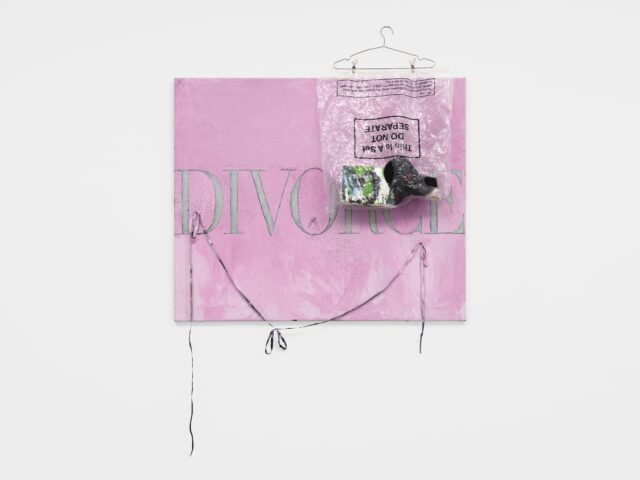
In a series of paintings emblazoned with the word DIVORCE, rendered in Vogue magazine’s recognisable typeface, the artist Jasmine Gregory turns her gaze towards these occluded processes, forcing the art market to confront its own material realities. Each painting differs from the others aesthetically; one shimmers in the light, one sweats out resin raindrops. In one, exhibited in Basel, certain letters were highlighted while others were muted, spotlighting the word DIOR. One bears an optional accessory, a transparent shopping bag stating “This Is A Set: DO NOT SEPARATE”, which contains a smaller painting and a piece of merch: a black DIVORCE cap. Some have Gregory’s painting palettes and other pieces of studio debris affixed to them, a maximalism that can’t help but evoke the junkyard overflow of the internet. In their eclecticness, these paintings are all different while still being the same – just like love stories. Or divorces.
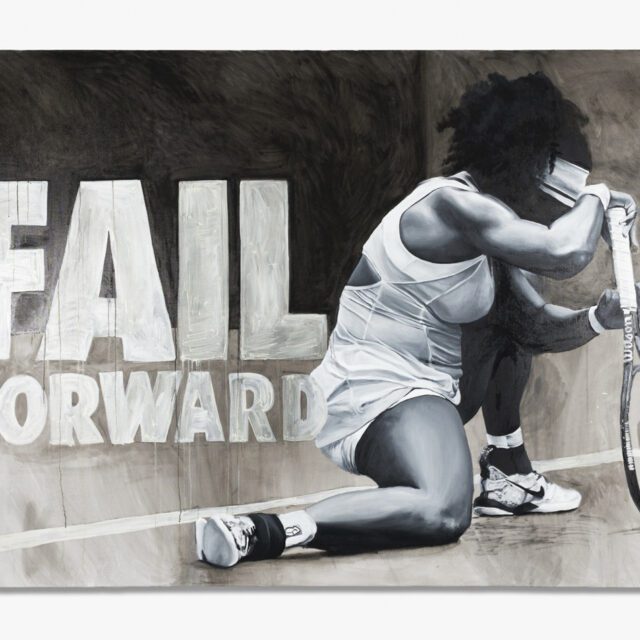
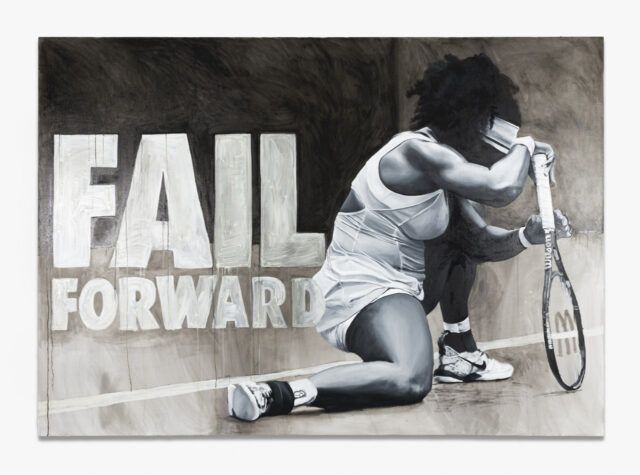
Gregory regularly employs the visual language of advertising to explore fantasies of wealth, elitism, inheritance, and ambition. In 2025, she showed the DIVORCE paintings alongside a realist rendering of a black-and-white Nike ad that features Serena Williams crumpled in a pose of agonised defeat alongside the slogan FAIL FORWARD. The original advertisement reflects the late capitalist (we could also say neoliberal) attempt to monetise failure, a predictable twist for our era of endless austerity, polycrisis and American imperial decline. The advert’s use of Williams as a poster girl for the supposedly universal imperative to optimise failure is telling, given that the most severe career challenges she has faced have been rooted in misogynistic racism. In reality, the political and economic conditions of our world tend to totally deny Black women the opportunity to fail forward, yet the Nike ad positions Serena Williams’s resilience as everybody’s inspiration.
In this way, Gregory confronts an elite world, where art functions as a luxury commodity, with the disturbing image of its own reflection. While at once acknowledging divorce as a rare rupture in the fanatical accrual of value and status, she also makes a joke out of the idea that divorce might be a kind of luxury product. But is it really just a joke? As I write this, London’s buses and tube stations are emblazoned with ads for Amicable, a tech-forward legal service that promises to make divorce “kind and fair”. “42% of marriages in the United Kingdom end in divorce, yet we still treat it as a failure rather than a new beginning”, Amicable’s website intones, putting its own spin on Nike’s urge that we turn failure into an opportunity for (emotional, but really economic) growth.[2] Again, the formula is a classic Silicon Valley move, rehabilitating every difficulty intrinsic to human existence into a missed opportunity for optimisation. Divorce may be a fact of life, but heartbreak is an avoidable inconvenience. Why stare into the abyss of an unravelled future when Amicable’s downloadable divorce timeline and co-parenting e-book are right there?
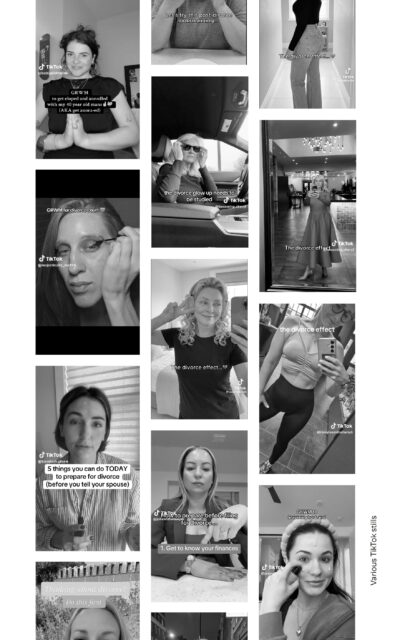
It’s easy to make fun of the fantasy of frictionless divorce, but Amicable is not alone in its attempt to rebrand divorce as not only navigable, but aspirational. On TikTok, where the discourse about men, heterosexuality and relationships is heavily clouded by a sense of doom, any woman announcing that she is leaving her husband tends to be greeted by a fanfare of rapturous identification, envy and applause. The chance to watch a separation unfold in real time seems to be one of the app’s main attractions: some of its most popular content consists of videos of women debating whether to leave their partners, preparing to theatrically expose knowledge of their cheating, driving away from their shared home, or conducting a kind of discursive postmortem of the relationship.
Perhaps the strangest of these microgenres is ‘GRWM [get ready with me] to break up with my boyfriend’, a makeup/break-up fusion spectacle that tantalises viewers with the suggestion that we know someone is going to be dumped before he does. A blonde woman from Florida, her hair wet from the shower, begins one such video: “I literally just watched another girl post one of these, I’m like, Oh my God, what a great thing, but that could never be me. Two weeks later…” She shakes her hand at the camera, as if to say, here we are.
It is no secret that TikTok tends to inspire some rather unhinged copycat behaviour. The app has been subject to multiple lawsuits over its viral ‘challenges’, particularly the Blackout Challenge, which plaintiffs have connected to the deaths of several children around the world. Still, it is surprising to hear the casualness with which this Floridian woman frames a ‘GRWM to break up with my boyfriend’ video as aspirational. God, what a great thing: could this be an indicator of a larger shift in attitudes towards separation?
The recent boom of the literary divorce memoir subgenre would suggest so. While some of these books harbour a more ambivalent relation to divorce than others, all seek to find something redemptive in the experience of separation. From a political perspective, this is hardly surprising. The slow liberalisation of divorce law – the UK did not implement a no-fault divorce option until 2022 – is generally recognised as a feminist victory. Because women are psychologically, economically and physically harmed by their legal spouses at far greater rates than men, the ability to leave a marriage without excessive repercussions is an essential component of women’s civil rights. As far-right Christian fanaticism takes over the United States, accessible divorce has become one of its major targets.
At the same time, a certain murkiness has engulfed the connection between divorce and feminism, as the role of wealth and whiteness in making divorce aspirational goes unmentioned and the main-character syndrome fuelled by the internet drastically escalates the collapse of the boundary understood to exist between mundane relationship issues and abuse. Hermione Hoby opens her recent survey of contemporary divorce memoirs for Bookforum with an anecdote in which a friend gleefully announced to her that they were all members of a ‘Hot Divorcees Club’. “Something shrank and recoiled in me”, Hoby writes, recalling her aversion to this imperative to fail forward. “Why must we be hot? Couldn’t we just be divorced?”[3]
Hoby observes that the wave of divorce books are “overwhelmingly authored by a certain kind of woman: she is white, straight (or at least separated from a man), cisgender, middle-class, and in her thirties or forties […] She belongs, in other words, to one of the demographics whose members are least likely to be socially punished or economically penalized for getting out of a marriage.”[4] It is unsurprising that this demographic is in the business of redeeming divorce as an opportunity for self-discovery, self-care and self-reinvention; it is only these women for whom such optimisation is plausible.
In Colored Television, her excellent 2024 novel about the disappointments of middle age, Danzy Senna emphasises this point through Jane, her downwardly mobile protagonist. Jane is a Black writer, the product of an interracial marriage that ended in divorce (from what Jane memorably calls the “Hating versus State of Virginia” generation), and in an increasingly unstable marriage with her husband Lenny, a Black visual artist.[5] Reflecting on a friend’s divorce and wondering if she might be next, Jane muses on the aspirational status of divorce in certain circles:
Jane had met wealthy women over the years who talked about how much better their lives were after divorce. They always seemed to be trying to convince Jane and all the other married women they knew to join their new religion. They had so much more time to themselves, for self-care […] They could go to wine tastings with girlfriends, fuck that hot plumber or cute barista, do yoga and go to brunch and browse in bookstores – or just lie in bed scrolling on their phone for hours.[6]
It is telling that this post-divorce euphoria revolves not only around women with sufficient disposable income to indulge in expensive hobbies like wine-tasting, but a fantasy of sexual dalliances with working-class service people (see “that hot plumber or cute barista”). As the writer Vinson Cunningham has remarked about Miranda July’s blockbuster midlife separation-and-self-discovery novel All Fours, also published in 2024, the well-off female protagonist’s self-reinvention is dependent on encounters with people working in service positions.[7] Out of all this emerges the strange implication that women who do not have the resources for self-care – and who may not be “hot” – might as well stay in their marriages.
For Senna’s Jane, the outlook isn’t nearly so bright. “Without enough money for even a single home, the prospect of divorce looked a lot different.”[8] But the problem is not only material; Jane knows that on a symbolic level, she is also excluded from the possibility of entering the ranks of aspirational divorcees. Ranting to a stranger during the climax of an emotional crisis, Jane exclaims: “Maybe for a white woman of a certain income bracket, it’s exciting to be divorced. Liberating to watch it all go to shit. But a single mother like me is nothing radical. I do it, and it’s a statistic. It’s not radical or cute or even interesting at all.”[9]
The point here is not merely to scold the authors of divorce memoirs for unspoken racial and class bias, but to highlight how this bias manifests as a surreptitious ideology of individualism. Today, divorce and separation can be positioned as aspirational because they herald (for some) an opportunity to turn back to the self. No friction, no disappointment, no responsibility, no failure: all of these fantasies are contained within the idea of divorce as a kind of luxury object.
Divorce is a ubiquitous reality, a fascinating social form, and an essential freedom. In one devastating sense, it is, inescapably, a luxury, economically and legally withheld from millions of women worldwide. But obscuring what it actually involves – rupture, heartbreak, dissolution – by framing it as a luxury product risks escalating an already powerful trend in which more and more people are forgoing the risks and rewards of relation in favour of an empty, self-indulgent landscape of frictionless isolation.
Carlie Porterfield. ‘Real Estate Mogul Harry Maclowe and Ex-Wife Linda’s Art Collection Fetches Record-Breaking $922.2 Million’. Forbes, 16 May 2022
Marketing materials, Amicable
Hermione Hoby. ‘Reader, I Divorced Him’. Bookforum, winter 2025
Ibid.
Danzy Senna. Colored Television. New York: Riverhead Books, 2024
Ibid.
Critics At Large. ‘The New Midlife Crisis’. Podcast episode hosted by Vinson Cunningham, Naomi Fry and Alexandra Schwartz. The New Yorker, 23 May 2024
Danzy Senna. Colored Television. New York: Riverhead Books, 2024
Ibid.