Self-help is generally understood as the process of addressing a problem with the self without relying on professional help. These problems might range from depression to a lack of friends, a problematic habit, or skill acquisition. Over a period of time, someone with a problem implements a set of methods, acquired from others or self-devised, to eliminate or alleviate the issue. Although self-help has a very long history, it cannot be readily untangled from a neoliberal valorisation of the individual. After all, here at the end of history we must constantly improve ourselves, maximise our potential, and make ourselves more desirable for the sexual and labour markets (if those markets aren’t already one and the same).
However, I’m not interested in thinking through this aspect of self-help. When I think of this term, my mind calls up images of yellow books on a library shelf, or bright and engaging covers with huge serif lettering at the train station WHSmith. These images give way to a navy suit-wearing charismatic leader speaking to a room of 200 people, then to the TransDIY subreddit, then to a recent ad on the New York City subway promoting an AI device that is supposed to alleviate the consequences of loneliness. And then back to the reddit page. There’s something here. It is a kind of something that weighs my body down, makes me clench my jaw and my fists. It brings heat to my belly and a prickling to the side of my face. But hobbling just behind these initial movements that this something produces is something else that feels like freedom… A troubling mix of sensations. For myself and, I imagine, for many other transgender and/or transsexual people, self-help is and has almost always been a troubled thing. I will elaborate.
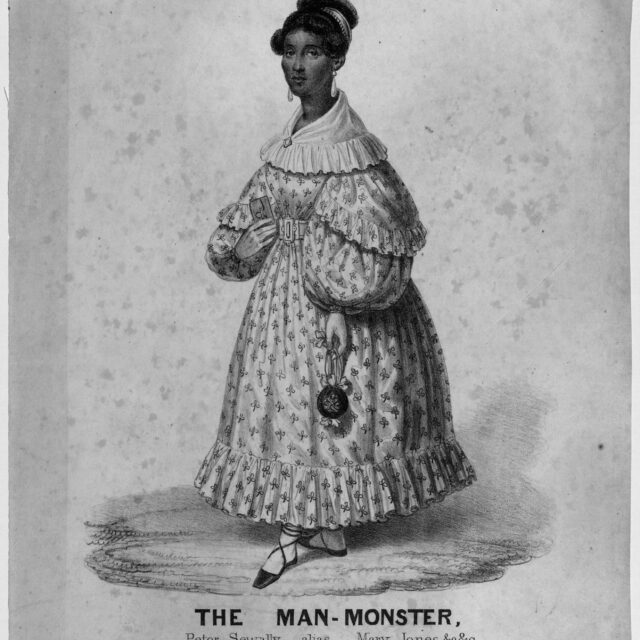
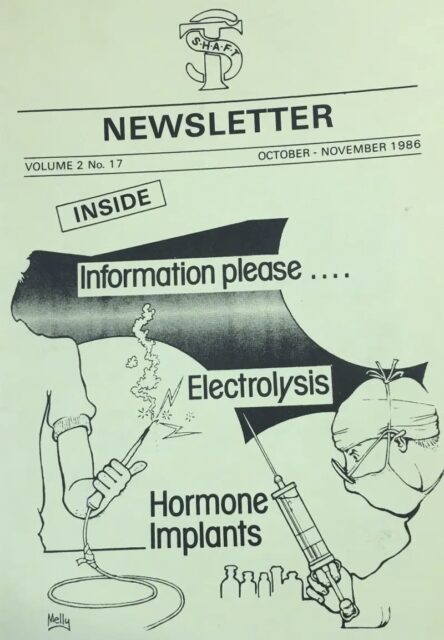
Across the world and throughout history, trans communities have developed formal and informal networks to support one another and, importantly, to exchange methods of physical and mental transformation. In mid-19th century New York City, the notorious transgender woman Mary Jones spoke of such a network: she recalled ‘waiting upon Girls of ill fame’ who ‘induced’ and encouraged her to ‘dress in women’s clothes’. After she engaged with this group of women, Jones was always ‘dressed in this way’ when attending parties in New Orleans and in New York. An earlier, more formal network can be found in the 3rd century BCE, in the temples of the Anatolian Mother Goddess Cybele. Her male priests, called Galli, created a set of castration procedures that would most likely have been shared between temples. This castration and their wearing of women’s clothing, makeup and hairstyles would explain why the Galli were not considered simple eunuchs, but known as ‘half-men’ or ‘half-women’. In the United States in the 1970-80s, people writing across letter networks shared the criteria for treatment which enabled trans women to access gender healthcare, while in the United Kingdom, organisations like the Self-Help Association for Transsexuals (SHAFT) advised trans people on how to navigate a hostile healthcare system.
Presently, the internet and other digital platforms sustain most of these knowledge networks. Beyond the aforementioned TransDIY subreddit, there are also Discord servers, TikTok accounts, and websites. These networks allow trans people to share information such as medical studies; dosages for hormone replacement therapy (HRT, in the case of transgender people, refers to the use of sex hormones and hormone blockers to change secondary sex characteristics); advice on how to feminise or masculinise the body through clothing choices; step-by-step guides on hip adjustment; and recommendations on how to swing the arms in a feminine way. From these methods, one can both tailor a transition regimen that – for many – includes hormone therapy, and access the resources needed to realise these steps, like tucking panties or GnRH agonists.
These networks have kept many trans people alive in cultures that have sought their erasure, where they manage to subsist despite efforts to decimate them. In the face of the rightward drift of many Western nation states, as state trans healthcare is being dismantled, these networks are ever more necessary.
In the UK – a place so hostile to trans people it is known in trans and queer advocacy circles across the world as ‘TERF Island’ – it is becoming almost impossible to access life-saving, gender-affirming healthcare. According to the NHS website, the maximum waiting time for non-urgent referrals on the NHS is eighteen weeks,[1] but for those seeking medical help with their gender dysphoria (a condition known to cause great distress and dysfunction, which can be debilitating), the waiting time to meet a specialist at a Gender Identity Clinic (GIC) ranges from 36 weeks in Inverness to 396 weeks in Exeter, with most clinics having a wait time over 160 weeks.[2] However, according to data obtained through freedom of information requests by Claire’s Transgender Talk (a service which aims to educate public and private organisations about trans people, and deliver training on how to work with trans people), the picture is even more dire, showing that the average waiting time across the UK is 25 years, with Northern Ireland’s reaching 41 years.[3] Scotland has an average wait time of 58 years – but in Glasgow, trans patients have a wait time of 224 years.[4] In other words, no one is being seen in Glasgow for treatment.
In this context, many turn to self-medication: the unmonitored use of hormones and androgen blockers to begin a physical transition that can alleviate their gender dysphoria. These hormones are sourced not from the NHS or private medical practices, but through online pharmacies or individual sellers who manufacture hormones in their homes. Initially, there were only one or two individuals on the internet with the knowledge and equipment to produce sufficiently safe and sterile medication for use, but in the last few years their numbers have grown significantly. And thanks to the growth of online spaces, it has become possible for users of these homebrewed hormones to feedback and review, and to develop detailed harm reduction protocols. Online guides circulate advice on how to order from reputable sources, and how to monitor hormone levels safely. Though these guides recommend ways of navigating interactions with GPs to secure blood tests without formal GIC referrals, this process is becoming increasingly challenging. Using the widely criticised Cass Review as justification, NHS England has guided doctors to refuse any care and support that would give under-18s access to gender-affirming care; the organisation also offers advice on ways in which GPs can deny support to adults who seek gender-affirming care. For those unfamiliar, the Cass Review was an independent report commissioned in 2020 by NHS England and NHS Improvement, which examined gender services for young people across England, and concluded that there was insufficient evidence to back up the use of puberty blockers for minors experiencing gender dysphoria. The review’s methodology, use of data, and conclusions have been criticised by national and extranational bodies and groups such as the Endocrine Society, the British Medical Association, the European Society for Child and Adolescent Psychiatry, the Canadian Paediatric Society, and Yale Law School’s The Integrity Project. Others have noted the lack of experience Dr Hilary Cass (who oversaw the review) has in the field of transgender healthcare, her Review’s engagement with transphobic organisations and parents, and its lack of engagement with trans individuals and trans advocacy groups.
The message sent by mainstream medicine is clear: trans people are not deserving of the same care as their cis counterparts. This is what caused the heat in my belly. For many of us, the closet is an impossibility. While the atmosphere of the closet is harmful to all of us, some of us are especially susceptible to its poisonous air. It disables many of us and slowly kills the rest.
Therefore, in order to survive, a lot of us seek to change the ways our bodies are seen – not simply by others, but also by ourselves. We achieve this through physical (medical) and social transition. However, in the UK, trans people have been abandoned and left to fend for ourselves, to provide our own life-saving healthcare. We, untrained in healthcare practices, have been forced to help ourselves, using techniques that require medical supervision. Because, while HRT is mostly harmless, in some cases it can cause drastic mood changes; damage the liver and kidneys in too-high quantities; or not work due to incorrect dosages or combinations of hormones and anti-androgens, which can lead to a deterioration in mental health. While there are harm reduction protocols shared on DIY networks, these only go so far.
Although this instance of self-help is driven largely by necessity, DIY networks of knowledge-gathering and -sharing open up alternative possibilities for transgender and transsexual people. These are distinct from yet entangled with the limited options presented by healthcare providers, who are encouraged to dismiss the desires of their trans patients – whether directly, as in the NHS England example mentioned above, or indirectly, through lack of education on trans healthcare. Trans healthcare has been plagued, historically and contemporarily, by doctors who require patients to become particular valorised types: hyperfeminine, no-trouser-wearing, submissive women; gruff, burly men who are detached from their emotions. From the late 1960s through to the 1980s, if a patient did not meet a doctor’s standard of womanhood/manhood, then they were refused care. In the US, this practice led trans women to circulate and study the set criteria in order to regurgitate exactly what the doctor wanted to hear, while in the UK, support groups like Transsexual Action Group and SHAFT guided trans folk to less harmful providers and methods of navigating Gender Identity Clinics.
Stepping or being forced outside of the healthcare system might mean that trans people can be whoever we want, and do not have to justify our desires to cisgender doctors who might never have met a trans person before and cannot believe that a real (trans) woman would not want to wear heavy make-up 24/7 and would not want to feminise her voice. Instead, we get to fashion a self and a body that is as close as possible to one we wish to see. These knowledge-accumulation and -dissemination networks enable trans people to have greater control over their bodies, and to handmake ‘queer(-er)’ bodies that disrupt patriarchal standards of being and Western notions of the human. The NHS, for instance, will not provide you with a penile preserving vaginoplasty, but the trans-surgeries subreddit will tell you where to find a surgeon.
What is needed is obvious: healthcare that takes seriously the needs and desires of trans people, that is driven by science and evidence, and that is buttressed against the ever-changing winds of politics. Every trans person, especially those who need to physically (medically) transition, should be in charge of their own journey – not doctors who have not examined their allegiance to patriarchal standards of masculinity and femininity. Until then, I guess I gotta help myself.

NHS UK. ‘Guide to NHS waiting times in England’
Transactual. ‘Gender Clinics’. 20 September 2025
Claire Prosho. ‘Gender Clinic Files: How I discovered the waiting times for every gender clinic in the UK’. QueerAF, 1 November 2025
Vic Parsons. ‘Gender Clinic Files: Some people in Scotland will never get a gender clinic appoint ment on a 224-year waitlist’. QueerAF, 4 October 2025