1 – ISLANDS OF ISOLATION
The world as we know it is ending,
and a new one is struggling to be born.
We are living through a time of deep uncertainty.
Through a time of collapse.
The transition is tumultuous. The grief is profound. And as we reckon with the gravity of this moment, searching for stability, we instead find ourselves amidst a crisis of socio-ecological disconnection – a state of collective unwellness. For many of us living within the ‘Imperial Core’,[1] this time is a lonely one filled with fear, grief and overwhelm. The circles of care we might have once held on to in times of social and ecological turmoil have shrunk so significantly that our entanglements with our wider communities and the living world are rendered illusory. Extractive capitalism relies on the perpetuation of this mass relational drift,[2] wherein our former Pangeas of connection are transformed into islands of isolation. Capitalism’s relentless hunger for growth and extraction pushes us further from each other and the living world, leaving all of us, human and nonhuman, exhausted, fragile and fragmented. Looking out from where you stand, you can see the edge of my shore on the horizon, as I can yours, but our islands are receding, unabated by our lack of collective strength and energy – not our lack of will – to draw closer and grow, once again, with each other. As our relational worlds become smaller and our isolation deepens, our access to webs of collective care diminish, substituted by the illusion/hope that self-care alone will protect us. Not the radical self-care introduced to us by the feminist scholar Audre Lorde as an organising strategy to build community resilience – an act of self-preservation – but instead as a practice of denial and disengagement. A commodification of care which thrives on concealing connection, selling a mirage of wellness that dismisses our immutable interdependence with each other and the living world.
It seems obvious that the disconnecting and isolating narratives – told, sold and manifested by us – about our individual and collective survival, our worth, and the future, are myths. Delusions. Still, we struggle to shift our gaze from the illusion of individualism in order to see the myriad assemblages of life that envelop and live within us. As the late and beloved teacher and author Joanna Macy reflects, “to truly perceive all life as interconnected, challenges many of our automatic assumptions about what we are and what we need”.[3]
And as we face collapse – the unravelling of this world into something new and unknown – should our assumptions not be challenged, upturned and remade? It is not reasonable, nor should we accept, the limited view that we must face collective threats to our wellbeing alone, with our survival and thriving determined by our relative political or economic power and privilege. It is not reasonable, nor should we accept, a bureaucratic, exclusionary and top-down approach to social organisation in which our ability to be heard and seen relies on whether those in power, or with privilege, want to hear or see us at all. It is not reasonable, nor should we accept, an ingrained inability to engage with healthy interpersonal conflict without the threat of division. We must instead, as the feminist scholar Donna Haraway asks us to do, disturb and stir up trouble within our societal ideals of what it means to be kin. To rebel against the West’s cult of individualism and suspicion, which tells us there is “no sense in having any active trust in each other, in working and playing for a resurgent world… to have an enduring mutual, obligatory, non-optional, you-can’t-just cast-that-away-when-it-gets-inconvenient, [kind of] relatedness that carries consequences”.[4] How do we disrupt and alter the course of our mass relational drift, transforming our islands of isolation into archipelagos of connection?
Easy to write – but where to start?
THROUGH COMMUNITY.
The phrase we hear chanted over and over again.
We witness collapse, we are urged to find community,
we witness destruction, we are urged to build community,
we witness division, we are urged to sustain community.
These words touch us, light something deep within us.
But there’s a strong draught.
As quickly as the kindling is lit, the fire is put out
by fear,
– no –
shame,
– no –
grief,
of knowing, experiencing, very little of what it means
to shape or be shaped by community.
So we stick to words, with the hope that this elusive state
of being with, relying on, caring for each other,
can be invoked merely by repeating
community,
community,
community.
Despite declaring their developmental superiority relative to the rest of the world, dominant Western systems have fallen severely behind in building the tools necessary to foster socio-ecological cohesion amidst collapse. A large gulf stretches out between where we who live within those systems stand, and the possibilities for more resilient, connected existences. A distance marked by our lack of philosophical and practical grounding in community-building and relationality, even within the social groups we are already part of, let alone with the rest of the living world. Faced with the threat of collapse, so many of us yearn for something different, to rewrite our story and nurture new ways of being and struggling together. After all, the word ‘collapse’ itself comes from the Latin root collabi, meaning to fall together, and is strikingly close to the Latin for collaborate, collaborare. Our task then is to let go of the isolating myths of Western philosophy and capitalism, and reconnect with worldviews and practices that can ground and guide us, as we
f
a
l
l
together.
II – PALAVER ECOLOGIES
In a myriad of forests.
Wind whispers to water.
Stone speaks unto stone.
Songbirds “unlock the throat of the sky”.[5]
And a great tree stands in the centre of a village,
listening to it all.
Witnesses, eternally
the harmonies and the dissonances.
Of life. Of us.
In communities across the continent of Africa, from Ghana and Nigeria to Senegal and the Democratic Republic of the Congo, threats to collective wellbeing – physical, spiritual, political, and ecological – are grappled with, not in the confines of one’s home or mind, but through palaver.
The English definition of palaver – unnecessary work or trouble; talking or discussion that goes on for too long and is not important[6] – exists at a distance from its original use and meaning, shaped by a deep disdain for African customary practices encountered throughout the colonial period. The term can be traced back to the mid-18th century, when British sailors adopted it from Portuguese, where palavra means ‘word, speech or talk’. Portuguese colonial traders had used it to describe the “ceremonial or customary requirement of elaborate discourse essential to their trading enterprises”,[7] built on pre-colonial social organisation customs within African communities. Informed by the derogatory perceptions of British colonialists, the English word palaver was “applied to virtually all fruitless negotiation or mere contact with Indigenous or colonial subjects”.[8] Regardless of the Eurocentric and imperial conceptions of palaver as unnecessary, inconvenient conversation, or a tool with which to advance the extractive and capitalist goals of colonial administrations, it has existed long before colonisation – and indeed before it was given a name by the Portuguese – as a diversely constituted and employed Indigenous African relational governance system centring repair, reconciliation, restorative justice, and remembrance.
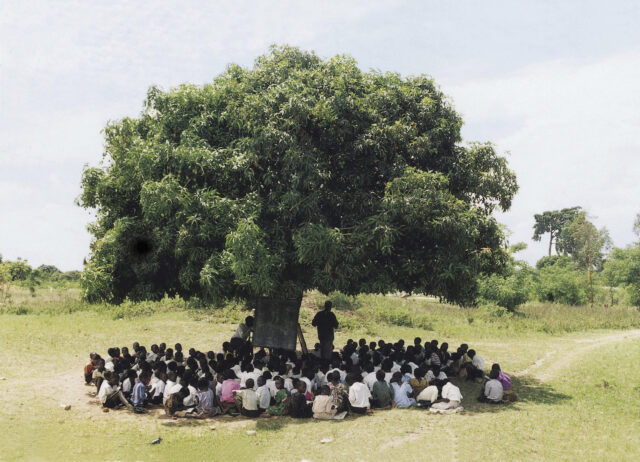
Palaver is a collective practice of dialogue that supports peace, healing, wellbeing, and cohesion through difficult times.[9],[10] Under the shade of a large tree, which is often located at the centre of the village, an entire community begins the ritual of open-ended dialogue. Through this assemblage of people and their subsequent dialogue, the shade is now that of the palaver tree. The palaver may be motivated by a specific event, by conflict, indiscretion or violence, or by a social or ecological challenge facing the community. But regardless of whether the disagreement or deliberation seemingly involves a discrete number of community members, everyone present is permitted to speak freely, to “pour out their heart, to give testimony or analyse”[11] the challenge placed at the roots of the tree. The species of this tree varies from country to country, village to village. In fact, the palaver tree is not only a physical place in which community can gather, but also a metaphysical “moral universe in which disputes are managed, truth is told and relationships are mended[:] an alternative technology of governance… that centres voice, belonging, and social repair”.[12]
This is unrecognisable in modern Western contexts – from boardrooms and international conferences to grassroots organising spaces and non-profit organisations – where ‘dialogue’ is often reduced to a series of rigid procedural discourses and debates, and within which freedom of expression, systemic analysis, the uplifting of marginal voices, and the challenging of the status quo are severely limited. But palaver is more complex, innovative and embodied than a normative Western understanding of debate or discourse, seeking resolution or conclusion not from a binary win-lose outcome, but through extended deliberations that include dancing, singing, riddles, storytelling, ritualised dialogue, non-verbal body language, recitations of proverbs, and even silence. It aims to uncover the root of the collective and spiritual ‘illness’ in order to preserve social cohesion.[13] Further to this, palaver exists across different perceptions and dimensions of time, for “there is no urgency under the Palaver Tree… [where] time is a servant to the process”[14] of achieving collective consensus, and thus, cohesion. Palaver concludes not when there is a ‘majority’ vote, and neither is it constrained by a particular, predetermined timeline. A single person is permitted to refuse the outcome of the palaver. For instance, in Somali pastoralist communities, an individual can invoke the phrase, “I refuse the decision of this shitty assembly”.[15] In this way, the outcome of the deliberations only becomes final “when all parties, even the marginal ones, express agreement”,[16] to ensure that proposed (re)solutions are truly sustainable. Under the palaver tree, the ego’s hunger for loud victory and fear’s desire for quick resolve must be quietened, in order to nurture the aliveness of the journey of restoration and achieve genuine togetherness.
Although it exists heterogeneously across a wide range of geographic and cultural contexts across Africa, at its core, palaver moves beyond seeing problems, conflict and collective threats as discrete issues that can be broken down into increasingly indivisible parts, solved only by an identified elite who dominate decision-making. Nor are these threats perceived as existing entirely within the realm of the individual, who must harbour, hold and resolve these issues alone. Instead, palaver is rooted in a worldview that sees “problems as systemic… and [that] tries to hold issues related to problems together in creative tension”.[17]
This approach is underpinned by the belief that there exists a ‘vital force’ that gives life and health, not only to each individual but to the community as a whole. Community, in many African cosmologies, extends beyond the visible human community, encompassing the invisible community, all more-than-human kin, including “one’s deceased ancestors… those not yet born and even God”,[18] as well as animals and the Earth itself. Communal cohesion, then, must be nurtured across space and time in all dimensions, and it is the work of all members of the community – “whether living, dead or unborn”[19] – to protect, nurture and enhance the collective vital force. It is from this deep and collective cultural, spiritual and social responsibility that palaver draws its power, because if the palaver were to fail, the vital force and wellbeing of the entire community – past, present and future – would continue to be threatened.[20] For to be well, and in fact to exist, is to be in communion and harmony with others.[21]

Placing our palms onto our chests, we – in the West – sense a void: perhaps the place our collective ‘vital force’ once inhabited. And yet, remnants of this force persist; its dim light flickers within us, waiting to be rekindled. But despite this draw, the distance between our islands of isolation and the unifying practice of collective, systemic, expressive, and open-ended dialogue seems immensely vast. We have found ourselves without footing, the foundations that may have held us through the discomfort of collective deliberation pulled out from beneath us. And so, our capacity to withstand and embrace the risks that practices such as palaver pose remains severely underdeveloped. The risk of unpredictability, the risk of power structures being challenged, the risk of accepted legitimacy being questioned, the risk of not being immediately understood, the risk of being exposed, including to one’s own internal “doubts, divergences and disagreements”.[22] However, it is by embracing these risks, facing them together, that we can develop the skills that set the foundation for communal resilience and allow us to draw closer to one another:[23]
- The ability to listen and learn actively, truly hearing and digesting what is being said.
- The capacity to suspend judgement while listening.
- The capacity to inquire and explore assumptions in order to have a ‘bigger picture’ about the issues discussed.
It will come as no surprise by now that the nurturing of these skills in cultures which centre palaver is also a collective endeavour, nurtured by many others throughout a person’s childhood and honed through practical, philosophical and spiritual exercises and beliefs. These have been developed over centuries and are held by firm socio-cultural foundations: the sacred role of anamnesis, cultural capacity-building, and the pedagogy of griots.
Anamnesis can be understood as the practice of remembering or recollection. But rather than a memory based on one person’s learned or lived experience, it signifies a connection to innate, universal, moral, and existential knowledge.[24]
In the African context, beyond Platonic definitions, anamnesis is a practice that preserves collective memory: the ability to understand, both cognitively and corporeally, how the community is constructed and how it must continue into the future. Anamnesis is the manifestation of the belief that “the past, present and future are a seamless expression of life”,[25] and it creates an essential link between innate individual and collective knowing. Within palaver, anamnesis plays a sacred and central role, calling on all community members to remember and reflect on the past, that which they have experienced in their current body, and that which the ancestors imbue in and through them as they shape their future. The conversations and deliberations within the palaver are not based on ‘fact’ alone, as would be expected in a Western discursive context, but also on communal truth “shaped by memory, morality and the relational context”.[26] In this way, palaver is a collective journey that requires all present to question not only the immediate challenge presented, but the lineage within, and generational repercussions of, their decisions. Rarely do we, in the West, experience this level of expansiveness. Of journeying and questioning together, intergenerationally. Of not being limited by formal proceedings and needing to constrain all that is authentic and deeply felt within us to preserve professionality. Of constructing, remembering and preserving collective memory through loving conflict. What would it look like to untether collective discussions on environmental and social breakdown from measures of carbon or dollars alone, which relegate the human and more-than-human world to the background? How might what we do be shaped not by the unpredictable and changeable desires of those who hold the most power, but by an inviolable and innate knowing of who we are, where we have been, and where we would like to go?
The strength and endurance of anamnesis is rooted in a community’s commitment to cultural capacity-building. From a young age, children in societies that practise palaver are invited into varying activities and exercises that acknowledge them as fully integrated members of the community, including initiation ceremonies, the telling of proverbs, legends and myths, and learning through game-play and reasoning exercises. These activities build “mutual trust, preparing minds, and establishing common norms for the exchanges, such as the spiritual and magical rituals, to prepare the ground for dialogue and reinforce the spirit of harmony and peace”.[27]
There is a very clear stage in early development in the West, where very similar capacity-building takes place. Where we are taught, through stories, myths and legends, about cooperation, overcoming adversity, and relationship-building. There is magic and goodness and wonder. Yet, somewhere in our schooling, formal and informal, this magic is lost, or rather taken away from us. Our training, although not exclusively, becomes more focused on grades, assimilation, conformity, competition, and the rewarding of individualised labour. And with no wider social structures like palaver to be trained to engage with, much of our social conditioning is primarily shaped by those on, or near to, our isolated islands: our families and close friends, potentially our coworkers. But how much do these intimate spaces of community help us build capacity for the risks and challenges of truly open, creative, spacious engagement with threats to collective wellbeing? It is in such fragmented spaces that our beliefs about the world are shaped, and in which the collective stories and memories we hold are cherry-picked, to be revered or hidden.
In the practice of palaver, collective memory is instead something that is preserved rather than fractured. This stewardship happens communally, but also through the deep and intentional training of young people who are born into a lineage of griots – the keepers of the collective memory and master storytellers in West African societies. Like the palaver tree itself, the griot exists both as a physical and metaphysical symbol and being, central to the stability of the community as a whole. Through storytelling, poetry and song, they steward knowledge, preserve genealogies and cultural values, shape collective identity, and mediate conflict, as is required in palaver. The role of the griot, storyteller or spokesperson within the palaver is an integral one; they are appointed not only based on how articulate they are, or how well they can remember and preserve the spiritual and earthly past of the community, but also on deep-rooted trust. They must, with detail, precision, power, and tenderness, translate “the concerns, grievances and perspectives of the individual, group or position they represent, ensuring that they are well articulated and accurately translated in the collective sphere”.[28] In times of creation and collapse, the griot holds and communicates the pain, grief, joy, fear, and essence of collective life.
This tradition of storytelling that is witnessed, enjoyed and practised by all, but stewarded and led by trusted members of the collective, extends across geographies and histories. From the Irish and Celtic seanchaí and bard to the Hakawati, traditional Arabic storytellers, many cultures have valued and continue to value the practice and profession of storytelling – through word, song and performance – as a central role within the community. Yet, in mainstream Western culture, storytelling is often perceived as unserious or frivolous work, or exists only as the words or images that help us wind down in the evenings. We forget that we are telling ourselves and each other stories, all the time. Capitalism is a story, xenophobia is a story, extraction is a story, division is a story. If everything is a story, we must question who is doing the telling and, importantly, how the stories we tell and those that we conceal shape the way we approach collective challenges.
III – NAVIGATING COLAPSE TOGETHER
There is a distance
looming, stretching, expanding
across time and space.
Between where we now stand
and where we only dare to dream we could be.
It’s a dark distance.
Abysmal.
An ocean of uncertainty
ripping currents of loss and loneliness,
real and imagined.
For it is not only loss between here and there.
Did you forget?
There is constructed in the here, the now.
So, we must navigate that deep, black ocean.
Discovering, locating, uncovering
the passage to where we are going
as we journey there,
together.
On our islands of isolation, we often accept that we are stranded. And perhaps, we think, it’s better that way: a safe remove from the unpredictability of other people, of the living world. There is enough labour and expectation on our islands as it is. Where would we find the time or energy to provide that for others beyond our shores? And even if we tried, the distance between our islands is treacherous and unnerving. Regardless, the world is ending anyway. Or at least, that is what we’re told: that we are stuck, doomed, our fatal course to collapse predetermined. So, why risk what we already have to traverse the perilous waters between us? But what if our islands, rather than tethered to the earth, leaving us forever stranded by sea, are instead floating rafts? Vessels in a constant state of flux, moving towards, away from and alongside each other. After all, our little worlds are only figments, however strong, of our collective imagination, informed by the limiting language of extractive systems. Why should we not reclaim the narrative, the story, the image? What if instead of waiting for collapse to descend on us, our survival dependent on our political and economic privilege, we journeyed towards it, a voyaging convoy of connected floating islands. An uncharted journey of possibility and connection, in which the future is made only as we move towards it. A journey through which we explore the vastness of the space between this world and the next, and in so doing, explore the vastness of ourselves, of multitudinous pasts, presents and futures. An attractive thought perhaps – but with no map, how can we guarantee safe passage?
Writing on hope in the face of collapse in the wake of the super typhoon Mawar, which tore through Guam in the summer of 2023, Guamanian human rights lawyer and defender Julian Aguon recounts a conversation with a traditional navigator.[29] The navigator reminded him of etak, a navigation technique developed by the people of the central Caroline Islands, which involves calculating your position at sea by triangulating the stars above three islands: the island of one’s departure, the island of one’s destination, and a third island off to the side, known as a reference island.[30] But when, as Aguon describes, “one’s destination is so far away that there are not enough reference islands to complete the triangulation”, the navigator creates a third island – which is called a ghost island – in his mind, “dragging it under its correlating star or constellation… until a real island is encountered, sometimes for hundreds of miles.”[31] A stunning and evocative metaphor, yes, but it is more than that. It is a cultural technology that constructs alternate, intermediate worlds to help us navigate uncertainty. Creating stability through faith in a shared vision. Much in the same way, for those open and expansive hours of communal, intergenerational and interspecies dialogues, the palaver tree becomes a ghost island. A co-imagined site of orientation that illuminates potential paths to togetherness. A portal that transports collectives through time and space on a journey of questioning and exploration in the face of social, cultural, political, and ecological collapse. Like a ghost island, palaver is a wayfinding technology that guides communities through difficult times.
Palaver is not a map. It is not the answer, but it is a source of inspiration for how we might navigate collapse together. An invitation to embrace the messiness of coexistence, build collective resilience through loving conflict, preserve collective memory, and question the stories that are told and who is telling them. Through practices like palaver, we are presented with an opportunity to moor our rafts together and sit for a while, transported by the currents of our collective reflection, deliberation and visioning towards our desired destination, on a journey through which new worlds are created.
Immanuel Wallerstein. ‘The Rise and Future Demise of the World Capitalist System: Concepts for Comparative Analysis’. Comparative Studies in Society and History, vol 16, no 4, 1974
The concept of mass relational drift first emerged in my first book, Natural Connection, where I use it to frame our relationship with systems, or the lack thereof, of radical care for each other and the living world.
Joanna Macy. ‘World as Lover, World as Self’. Engaged Buddhist Reader. Berkeley: Parallax Press, 1996
Donna J. Haraway. Staying with the Trouble. Durham: Duke University Press, 2016
Camille T. Dungy. ‘Language’. Black Nature: Four Centuries of African American Nature Poetry, ed. Camille T. Dungy. Athens: University of Georgia Press, 2018
‘Palaver’. Cambridge University Dictionary
Mira Shah. ‘A Word: ‘Palaver’ and Its Transferal Residues’. Word and Text, A Journal of Literary Studies and Linguistics, vol 4, no 2, 2014
Ibid.
Anna Floerke Scheid. ‘Under the Palaver Tree: Community Ethics for Truth-Telling and Reconciliation’. Journal of the Society of Christian Ethics, vol 31, no 1, 2011
Ali Moussa Iye. ‘From the Palaver Tree to the State House: A Reflection on the Tension between Dialogue and Governance in Africa’. Journal of Dialogue Studies, vol 11, 2023
Anna Floerke Scheid. ‘Under the Palaver Tree: Community Ethics for Truth-Telling and Reconciliation’. Journal of the Society of Christian Ethics, vol 31, no 1, 2011
Jean Yves Ndzana Ndzana. ‘The Palaver Tree and the Notions of National Tribunal and Republican Confessional: Reclaiming the African Conflict Resolution Ethos in National Dialogues’. ACCORD, 2025
Ibid.
Andrew Murray. ‘Under the Palaver Tree: A Moratorium on the Importation, Exportation, and Manufacturing of Light Weapons’. Peace & Change, vol 25, no 2, 2002
Ali Moussa Iye. ‘From the Palaver Tree to the State House: A Reflection on the Tension between Dialogue and Governance in Africa’. Journal of Dialogue Studies, vol 11, 2023
Jean Yves Ndzana Ndzana. ‘The Palaver Tree and the Notions of National Tribunal and Republican Confessional: Reclaiming the African Conflict Resolution Ethos in National Dialogues’. ACCORD, 2025
Andrew Murray. ‘Under the Palaver Tree: A Moratorium on the Importation, Exportation, and Manufacturing of Light Weapons’. Peace & Change, vol 25, no 2, 2002
Anna Floerke Scheid. ‘Under the Palaver Tree: Community Ethics for Truth-Telling and Reconciliation’. Journal of the Society of Christian Ethics, vol 31, no 1, 2011
Ibid.
J.M. ‘The Palaver. A traditional African path to peace’. SouthWorld.net, 2025
Anna Floerke Scheid. ‘Under the Palaver Tree: Community Ethics for Truth-Telling and Reconciliation’. Journal of the Society of Christian Ethics, vol 31, no 1, 2011
Ali Moussa Iye. ‘From the Palaver Tree to the State House: A Reflection on the Tension between Dialogue and Governance in Africa’. Journal of Dialogue Studies, vol 11, 2023
Ibid.
Dominic Scott. ‘Platonic Anamnesis Revisited’. The Classical Quarterly, vol 37, no 2, 1987 25
Anna Floerke Scheid. ‘Under the Palaver Tree: Community Ethics for Truth-Telling and Reconciliation’. Journal of the Society of Christian Ethics, vol 31, no 1, 2011
Jean Yves Ndzana Ndzana. ‘The Palaver Tree and the Notions of National Tribunal and Republican Confessional: Reclaiming the African Conflict Resolution Ethos in National Dialogues’ . ACCORD, 2025
Ali Moussa Iye. ‘From the Palaver Tree to the State House: A Reflection on the Tension between Dialogue and Governance in Africa’. Journal of Dialogue Studies, vol 11, 2023
Ibid.
Julian Aguon. ‘Hope Is a Ghost Island’. Progressive International, 2023
Ibid.
Ibid.