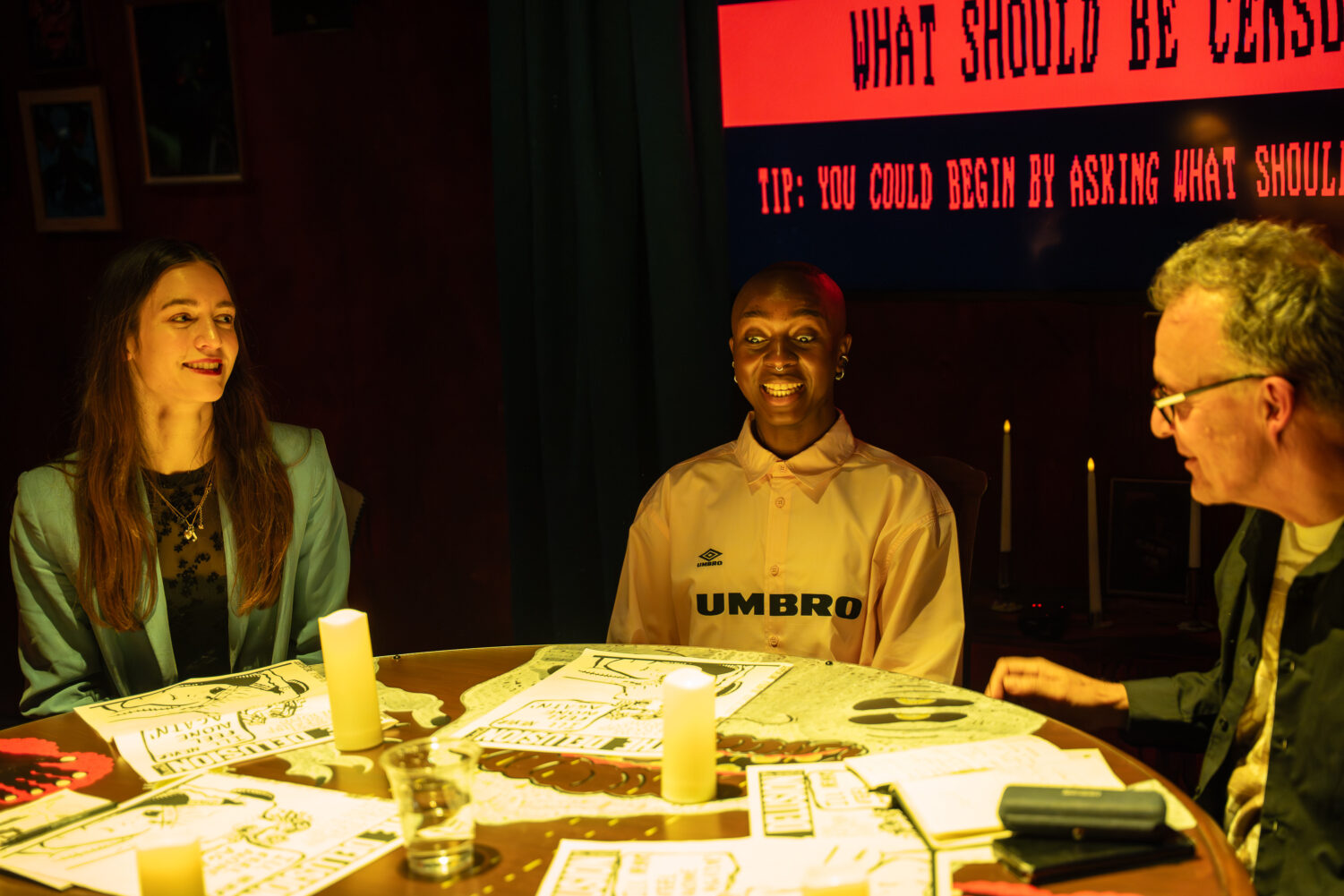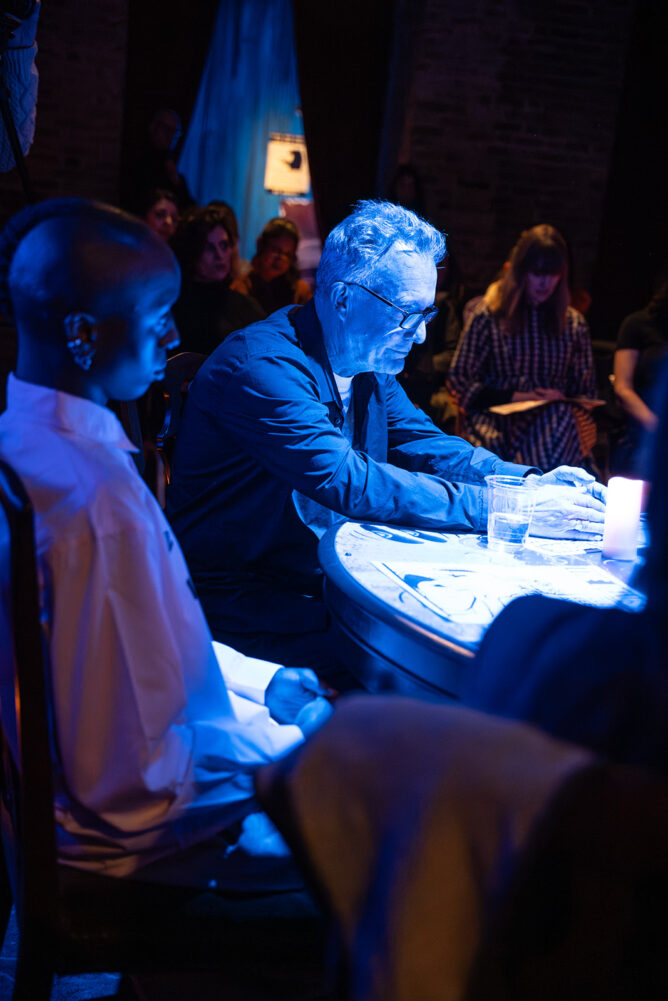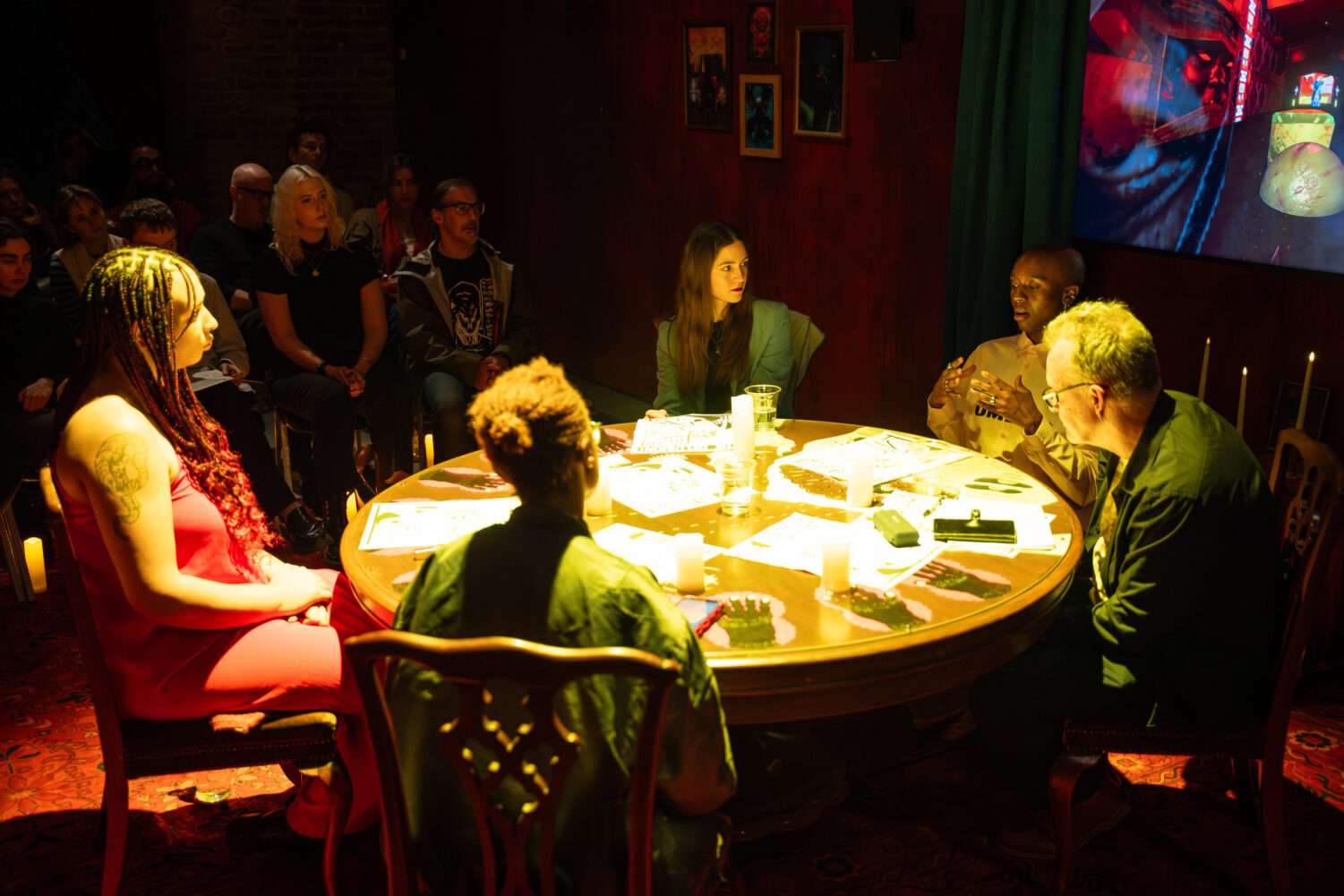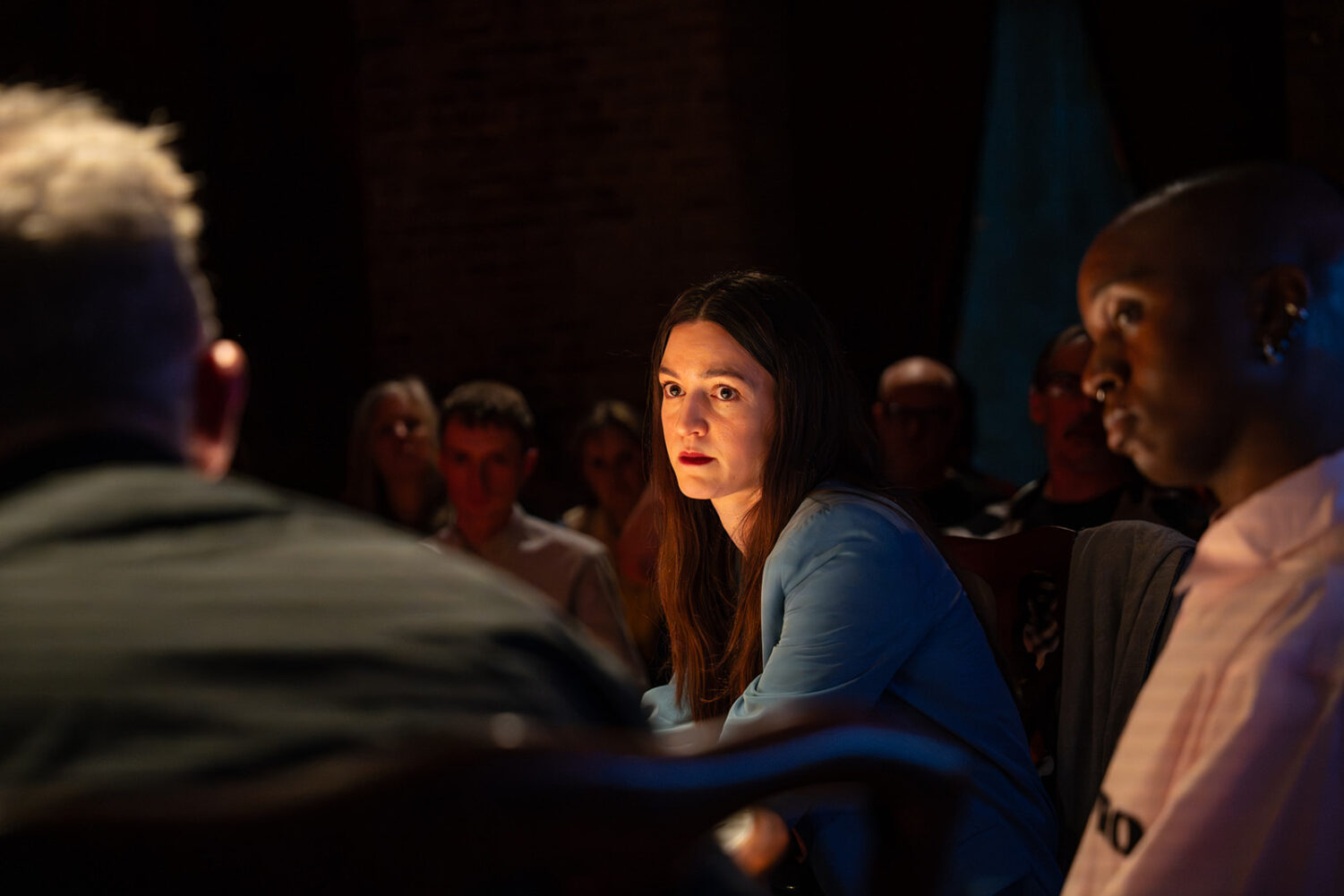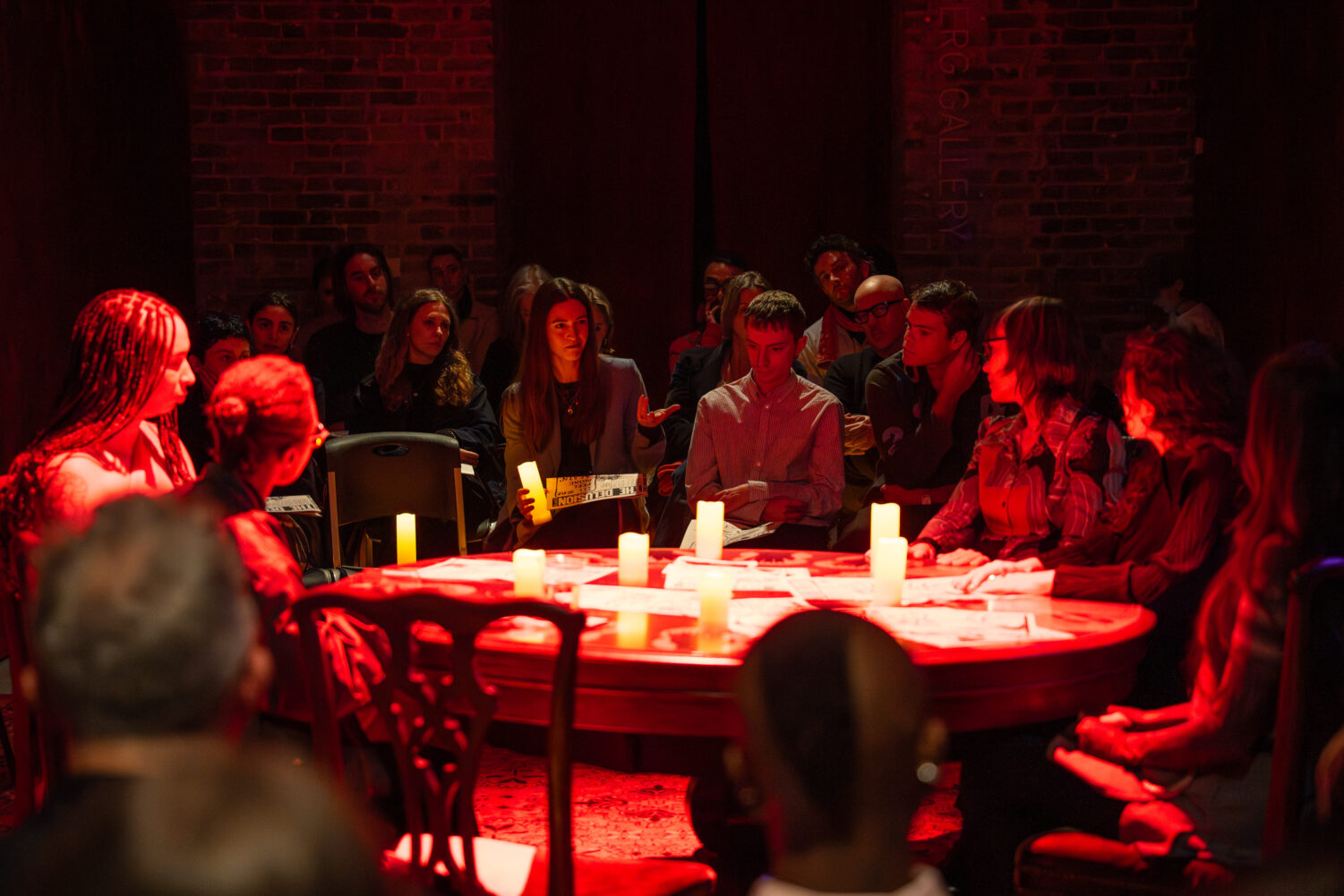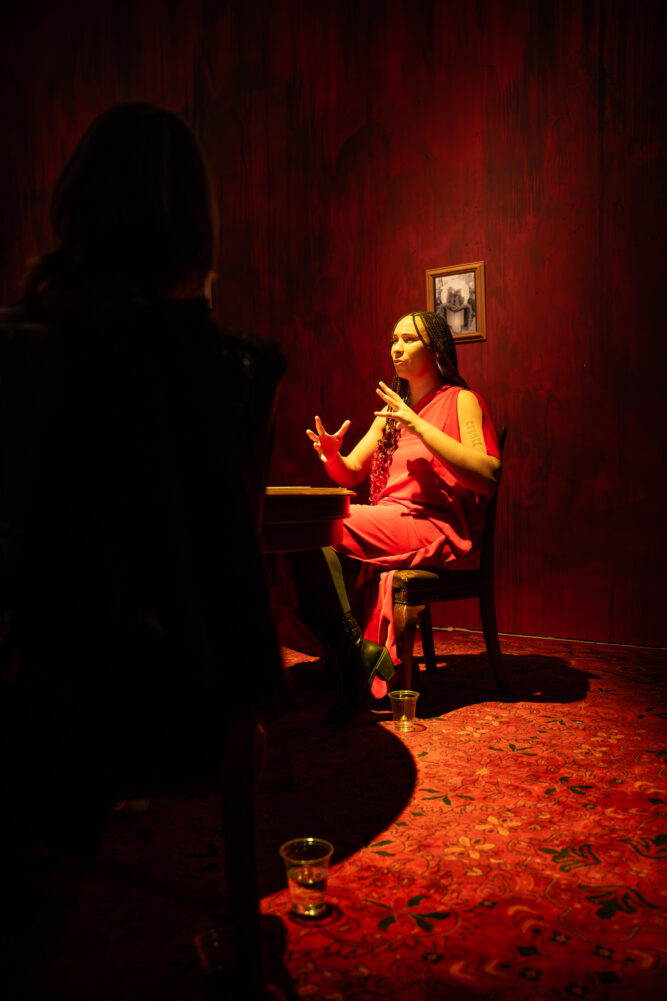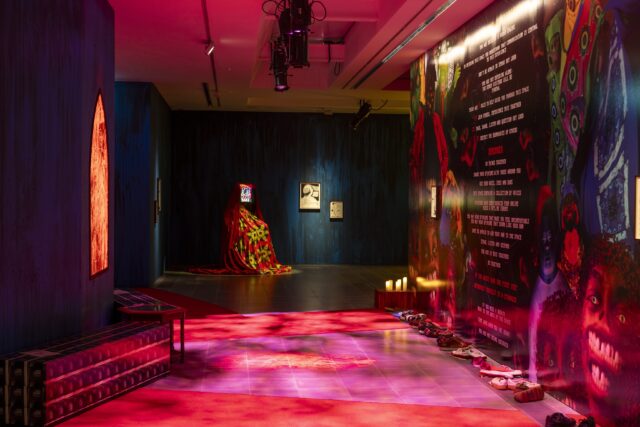
Hosted by artist Danielle Brathwaite-Shirley, HOUSE IS IN SESSION turns THE DELUSION into a forum for transdisciplinary exchange. The evening explores crises of truth, faith and reality in our rapidly evolving digital world.
Informed by THE DELUSION’s focus on community archives, activism and R&D, HOUSE IS IN SESSION turns the exhibition into an open house addressing urgent questions around truth, faith and reality. Grounded in the artist’s participatory approach, the programme explores how we might challenge our digital dependence and re-engage with reality through critical thinking and radical action.
The evening invites researchers, practitioners and the wider public to reflect on issues raised by THE DELUSION, guided by the key question: HOW CAN WE WORK TOGETHER WHEN WE CAN’T SEE EYE TO EYE? Roundtable discussions consider the role of digital media in polarisation and societal fragmentation, while artist-led exercises encourage new approaches and generative actions in times of uncertainty.
Drawing on interdisciplinary perspectives from psychology, political science, media studies and game scholarship, invited guests examine the contemporary “polarisation loop”: the cyclical relationship between extreme messaging, emotional engagement, media amplification and social division. The session aims to spark dialogue, build literacy, encourage reconnection and imagine new possibilities for collective action.
The evening will close with free game play until 10PM.
THE DELUSION was conceived by the artist as a “live community play” and community meeting space that aims to rehumanise debates and provide space for visitors to pause, discuss and reconnect.
HOUSE IS IN SESSION is supported by the Future Art Ecosystems initiative, which offers a cross-sector research forum for public interest by involving and convening publics in and around technological phenomena; sets new strategic visions by expanding collective imagination through alternative technological futures; and, engages in systemic intervention by building tools, infrastructure, and operational entities.
7PM – Doors open
7.10PM – Introductions & Exercise
7.20PM – Roundtable – Laughing Alone in your Room: Addictive Design & Algorithmic Attachment
What began as a tool for expanding knowledge has become a mechanism for restricting it. Algorithms curate our reality based on what keeps us engaged, transforming us into compliant participants in an economy built on capturing attention. A discussion about digital dependency, addictive design and collapsed critical thinking. This conversation explores digital saturation, habit-forming interfaces, and the erosion of reflective thought. From platform algorithms to reward mechanics, aesthetic comfort zones, mood-driven culture, cognitive decay, ideological isolation, and self-reinforcing belief systems—what does this emerging mental landscape mean for us, and is there a way out?
7.50PM – Exercise
8.00PM – Roundtable – Designing Belief: Troll Armies, Propaganda Puppets & the Polarisation Loop
Internet polarisation is widely recognised as a significant factor in fostering social division, heightening animosity between groups, and eroding a shared, fact-based understanding of the world—often interpreted as an erosion of common sense. Within this rapidly evolving digital ecosystem, new forms of weapons have emerged, hate campaigns, disinformation efforts, and organised trolling that function as socio-political weapons rather than mere by-products of online interaction. This discussion explores the relationship between belief and technology, examining how digital technologies and platforms shape the formation of ideology and the dynamics of public opinion.
8.30PM – Exercise
9PM – Free game play
10PM – Doors close
Bios
Danielle Brathwaite-Shirley (b. 1995, London) lives and works between Berlin and London. Working predominantly in animation, sound, performance and video game development, and with a background in DIY print media and activism, the artist’s practice focuses on intertwining lived experience with fiction to imaginatively retell and archive the stories of Black Trans people. Danielle utilizes interactive technologies to create participatory spaces that challenge traditional narratives and encourage active engagement. Their projects often take the form of immersive video games, where players navigate choices that confront their assumptions and biases, fostering deeper conversations about identity, privilege, and systemic oppression. Through their innovative use of digital media, Danielle not only preserves histories but also envisions inclusive futures where the voices of those that are ignored or erased are central. Their work is both ‘archive and insurgency’, a catalyst for dialogue, inviting audiences to reflect on their roles within broader societal structures.
Dr Julia Ebner is a Calleva Researcher at the University of Oxford where she leads the Violent Extremism Lab at the Centre for the Study of Social Cohesion. She is also Co-Executive Director at the Institute for Strategic Dialogue, where she has worked on projects on online radicalisation, terrorism, conspiracy myths and hatespeech. Julia is an award-winning and internationally bestselling author of several books, including The Rage: The Vicious Circle of Islamist and Far-Right Extremism, Going Dark: The Secret Social Lives of Extremists and Going Mainstream: How Extremists Are Taking Over. Based on her research, she has given evidence to numerous governments, as well as advised intelligence agencies, tech firms and international organisations such as the UN, Europol and NATO. She has written for media outlets such as the Guardian, Financial Times, Washington Post and Süddeutsche Zeitung and regularly gives public talks and guest lectures at universities in the UK, Europe and the United States. Julia holds a DPhil in Anthropology from the University of Oxford and a dual Msc from Peking University and the London School of Economics.
Dr. Phoenix Perry researches embodied interaction, small-data machine learning, data commons, and the ways people develop cognitive models to understand AI systems. As a Reader at UAL, they develop tools and practices that enable more accessible, context-aware, and inclusive approaches to engaging with computation. Through their open-source projects, such as InteractML, they support artists and designers to create embodied machine learning interactions in game engines. Their creative work centers on developing experiences that amplify somatic experiences in groups to propose new ways of sensing and inner connecting audiences
Alex Quicho is a theorist in London. Her practice develops novel ways of understanding life within technological systems, unfolding in multi-year cycles through critical writing, performative lectures, and moving image. Past major projects include Girlstack (2023-25), an investigation into the planetary impact of inhuman ‘girl’ intelligence; Alley to Heaven (2021-23), a trilogy of videos and performances on data annotators and edge computing in the contested South China Sea; and Small Gods (2017-20), a book of departures in drone narratives. Her work has been featured in Wired, Frieze, Dazed, Vogue, Spike, The Face, MIT Journal, and more. Alex has collaborated with arts institutions including Tate Britain, Somerset House Studios, Singapore Art Museum, Power Station of Art Shanghai, Julia Stoschek Collection, Nationalgalerie Berlin, Fondation Pernod-Ricard, and Rennie Museum. In 2025, she was a mentor at Medialab Matadero and a research fellow at the Weibel Institute for Digital Cultures. She teaches theory for MA Narrative Environments at Central Saint Martins, and studied Critical Writing at the Royal College of Art. She is from Manila, where she is in leadership of SYM.
Kumbirai Makumbe is a London-based artist whose work is, through a Black queer feminist lens, an ongoing exploration of fabulation—not just storytelling, but worlding through elements of myth, Shona folklore, and speculative fiction. Rather than focusing on a single narrative, they see their practice as a growing ecology of support structures for thought, transformation, and survival. Each concept acts as a site of speculation, self-definition, and holding.
Dr Romy Gad el Rab is a Psychiatrist, researcher, and artist exploring our intimate entanglements with technology. Working in the NHS’s first centre for Internet Gaming Disorders, she combines clinical insight with interactive installation and performance to question digital addiction and the power structures behind networked systems. Her work has featured in programming at Tate, Somerset House, and Delfina Foundation, where she was a UK Associate for their 2025 thematic season, science_technology_society. A published academic and curator, she creates spaces where science, technology, and art meet through conversation, research, and making.
Dr Tony D. Sampson is a Reader in Digital Communication in the University of Essex’s Business School (EBS). His research spans two interconnected strands concerned with lived and felt experiences in both (a) the digital economy and (b) community engagement with culture, heritage and “natural” environments. Across both research strands, Tony examines how the tangible and intangible environments people inhabit evoke, shape, or suppress experience. His work investigates affective relations and their role in shaping how experiences are produced, understood, and transformed. This contributes to critical debates surrounding power, inclusion, and marginalisation in both virtual and physical contexts. In the digital context, Tony has published widely on digital communication, marketing, labour, virality, neuroculture, and user experience (UX). His publications include numerous monographs, edited volumes, and journal articles, such as: The Spam Book, co-edited with Jussi Parikka (Hampton Press, 2009), Virality: Contagion Theory in the Age of Networks (University of Minnesota Press, 2012), The Assemblage Brain: Sense Making in Neuroculture (University of Minnesota Press, 2017), Affect and Social Media, co-edited with Darren Ellis & Stephen Maddison (Rowman & Littlefield, 2018), A Sleepwalker’s Guide to Social Media (Polity, 2020). Tony’s forthcoming The Struggle for [User] Experience examines the cultural pervasiveness of experience design.
Hosted by Danielle Brathwaite-Shirley
Event produced by the Serpentine Arts Technologies team