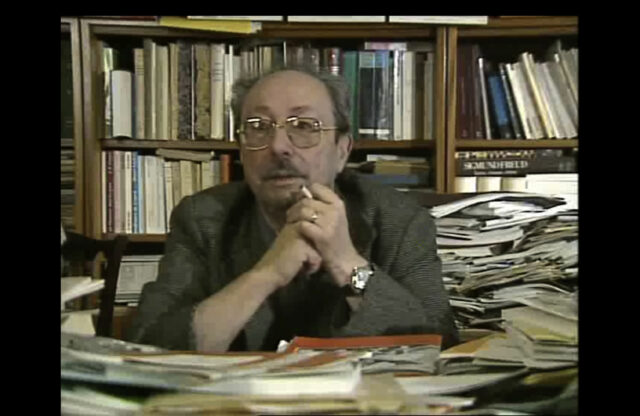
In his 1989 film François Tosquelles: Une politique de la folie, François Pain trains his lens on his own analyst: the Catalan psychiatrist François Tosquelles. Early in the film, Tosquelles describes how he assembled ad-hoc psychiatric services on the front lines of the Spanish Civil War. “I threatened the brothels”, he explains, “I said I would close them” – unless their owners agreed to let three or four of the women working there train as nurses. “Some of these hookers (putains)”, he observes, “became nurses with a lot of enthusiasm. It was extraordinary! After all, they knew, from their experiences with men, that everyone is mad, including the men that go to hookers.”[1]
Une politique de la folie, a one-hour documentary, takes us from Tosquelles’s childhood in Reus to his time as a member of the Workers’ Party of Marxist Unification (POUM) to his exile in southwestern France during the Second World War. It was in France that Tosquelles began working at, and eventually came to lead, a psychiatric institution in Saint-Alban-sur-Limagnole where, with collaborators including Frantz Fanon, he helped to develop the anti-hierarchical model of collective care now known as institutional psychotherapy.
In the words of Jean Oury, who worked as an intern at Saint-Alban, institutional psychotherapy is in part “the act of setting up all kinds of mechanisms to fight, every day, against all that could turn the whole of the ‘collective’ towards a concentrationary or segregationist structure.”[2] Félix Guattari explained the movement in similar terms:
After the prison camps and concentration camps, a few nurses and psychiatrists started to look at the problems of psychiatric hospitals from an entirely new angle. Incapable of supporting concentrationary institutions, they undertook to transform services from top to bottom […] Surrealist intellectuals, doctors strongly influenced by Freudianism, and Marxist militants all mingled.[3]
On a day-to-day level, this meant that patients and staff, including the doctors and the nurses, lived together, ate together, socialised together, and jointly participated in the maintenance of the hospital. It also meant that they made art, put on plays, wrote poems, and printed newspapers for the community to enjoy. In this model, rather than being accepted as a space of internment and a locus of punishment, the hospital becomes a sheltered space where the patient learns to take responsibility for his own wellbeing and the wellbeing of his comrades. The order of the day is a practice of self-help that unsettles the very idea of ‘the self’, treating it as a communal construction instead of an atomised agent.
The goal of treatment in the asylum is the same as it is on the couch. Tosquelles believed that, whether a patient suffered from psychosis or neurosis, whether he was working-class or bourgeois, his purpose was to become who he really is. This in turn requires ‘a cultural change in worldview’.[4] The point is not to stop being crazy since, on some level, everyone is crazy. The point is to be able to identify what in the world is making you sick, and to begin to reconstruct your personality in opposition to this toxic state of affairs. The self is always collective and so are its ills. We may experience suffering as discrete and private, but chances are that it is historical and, if not exactly public, at least widely felt. To quote the slogan of Feel Tank, a group of artists, activists and academics based out of Chicago in the early 2000s: ‘Depressed? It Might Be Political.’[5]
Where do the sex workers fit in? Tosquelles says it quite plainly: no one knows better that all men are mad. His nurses were not required to sleep with their patients, but they were encouraged – according to the scholar Joana Masó – to write reports on their charges’ sexuality. “They could welcome them through words”, Masó says, “without necessarily having sexual relations with them”– relocating libidinal energies from the bedroom to the blank page.[6]
Here, there is an assumption that sex is related to care. A suffering exists that wants to be welcomed through words, through a scene that is collaborative and compassionate, free of aggression or power games. Tosquelles’s gambit seems to have been that the sex worker, like the madman, has nothing to lose, having already been rejected from polite society. A provisional equality exists between nurse and patient, and this in turn clears their relation of the psychosexual complexities of shame or guilt.

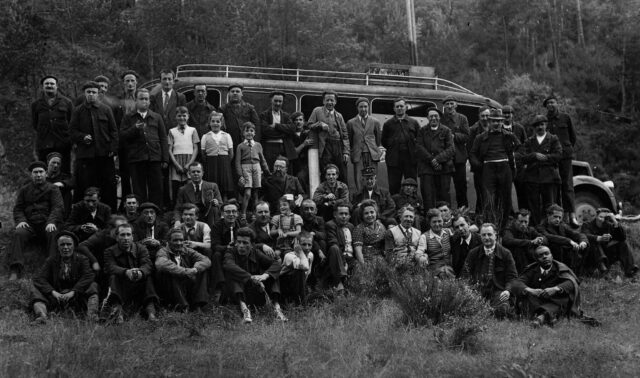
For Masó, it’s crucial that we understand the sex worker as instrumental to the evolution of institutional psychotherapy. Consider just how radically this notion undermines the more familiar psychoanalytic stereotype of the hysteric: the woman who is so frightened by her sexuality and the sexuality of others that it drives her to all sorts of chaotic and self-isolating behaviours.
If psychoanalysis has what advertising language would term a ‘face’ or a ‘brand ambassador’, the hysteric would be it. Fragile but loud, intense yet intensely vulnerable, the hysteric somatises her internal conflicts, converting repressed traumatic experiences into fainting fits, convulsions, spasms, and episodes of hypersexuality or hyperbolic self-denial. In the 1980s and 1990s, the female anorexic seemed to take over as the paradigmatic figure of bourgeois psychopathology, but in truth this figure was just a millennial adaptation of the hysteric. Her shadowy counterpart was the female stalker. For every Karen Carpenter or Tracey Gold, pop culture at the turn of the century gave us an Alex Forrest or an Amy Fisher, the spurned mistress who turns murderous in her anger and shame.
In place of the hysteric, that Freudian icon of female instability, institutional psychiatry gives us the hooker. Unlike the hysteric, who is almost always une bourgeoise, the hooker is a worker, someone who makes money using what the hysteric cannot bear to acknowledge without ambivalence. By placing the sex worker (albeit through coercion) at the centre of his institutional model, Tosquelles gives the work of psychiatric care or healing a very particular, and peculiar, cast. He aligns it with eroticism, yes – but also with labour and with the rejection of taboos. The ‘cultural change in worldview’ effected by good psychiatric treatment begins here, with the recognition of sex work as a form of social and psychological competence.
It is now 2026. Saint-Alban, now the François Tosquelles Hospital Centre, is no longer a home for institutional psychotherapy but a site of what Oury called ‘technocratic simplism’, meaning a place where bureaucracy and pharmaceuticals collude to produce a docile population of sick people.[7] In that sense, it is a microcosm of what passes for therapy in the 21st century. Psychic suffering is treated almost exclusively with medication and in isolation: the patient pulls up to the pharmacy counter, receives her pills, and goes home to scroll on Instagram, where post after post and meme after meme feed her conflicting advice about how to become a better, stronger, happier person – all by herself.
I’m using feminine pronouns here, but isn’t it true that the paradigmatic lunatic is no longer a young girl flailing on the ground, starving herself, or shooting her lover’s wife in the head? Isn’t it true that the figure of psychic pain in our era is now the young boy, alone in his room, addicted to video games, falling down the sewer of the so-called manosphere? Where there was once the hysteric, there is now the incel: the guy who can’t get laid and blames women for it. If incels once seemed like a subculture operating on the fringes of polite society, they have recently gone mainstream. Consider the explosive popularity of the Netflix show Adolescence, which Prime Minister Keir Starmer supports streaming for free to secondary schools across the United Kingdom.[8] It’s about a thirteen-year-old boy who kills a girl he likes who doesn’t like him back, and whom he is persuaded to think of as a slut.
But sexual terror and resentment cannot be cured by watching TV shows, no more than reading Go Ask Alice has kept anyone from using drugs. In the spectacle of forcing students to watch children talk about murdering other children, there is a grotesque inversion of what institutional psychotherapy sought to create: a shared space of emotional self-inquiry, where attitudes, phobias, neuroses, and fantasies could all be welcomed with words, together. Instead of encouraging sick or even just normally suffering people to make art together, we sit them in a classroom before a screen. Instead of acknowledging sexuality as a zone of human experience in which all people – ‘tout le monde’, as Tosquelles says – discover that they’re crazy, we insist on the outward presentation of perfect mental health, regardless of what lies beneath. Incel culture is vile and blighted, no question, but so is our contemporary regime of punitive isolation and shaming.
Institutional psychotherapy arose at a time when openly fascist governments were in charge of multiple European states. The asylum became a refuge, but also a place where play and experimentation could happen, simply because no one thought to look there. Populated by exiles and refugees, poets and prostitutes, the hospital converted social abandonment into social support, bringing together people who had no one so that they could find a kind of home. There they discovered the strangest thing: they already knew how to care for each other, and therefore how to care for themselves. In the asylum, they remembered who we really are. As our own historical moment becomes a grisly mirror image of the horrors of the 1930s and 40s, it is a lesson we’d do well to hold close.
François Tosquelles: Une politique de la folie, dir. François Pain, Danielle Sivadon and Jean-Claude Polack. Anabase Productions, 1989
Jean Oury. ‘Institutional Psychotherapy: From Saint-Alban to La Borde’, trans. Anthony Faramelli and Marlon Miguel. Psychotherapy and Materialism: Essays by François Tosquelles and Jean Oury, eds. Marlon Miguel and Elena Vogman. Cultural Inquiry, vol 31 (Berlin: ICI Berlin Press, 2024), pp 89–119
Félix Guattari. Quoted in Psychotherapy and Materialism, p 6
François Tosquelles: Une politique de la folie, dir. François Pain, Danielle Sivadon and Jean-Claude
Polack. Anabase Productions, 1989
Lauren Berlant. ‘Chapter 31: Feel Tank’. Counterpoints, vol 367, 2012, pp 340–43
Joana Masó. ‘Women of the Collective: Care and Politics around Saint-Alban Psychiatric Hospital: 1930–1960’. Parapraxis Magazine
Jean Oury. ‘The Hospital Is Ill’. Interview with Jean Oury, Mauricio Novello and David Reggio, Radical Philosophy, vol 143, May/June 2007, pp 32–45
Sylvia Hui. ‘“Adolescence” will be shown in schools across the UK to spark conversations on social media harm’. Associated Press, 31 March 2025